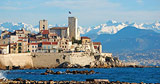
Villefranche-sur-Mer from Nice
The closest and one of the most beautiful escapes from Nice: the bay of Villefranche, carved into the rock, Cocteau's frescoes, a 16th-century citadel and terraces facing the water. Ten minutes by train are enough.
Some towns are visited, others are breathed. Villefranche-sur-Mer belongs to the second category: a deep bay carved into the rock, a colourful seafront, alleys climbing in Italian style and a citadel watching over it all. A few minutes from Nice, it's the ideal outing for an afternoon that never ends.
How to get there from Nice
Three ways, all easy:
- The train: a few minutes on the TER from Nice-Ville to Villefranche-sur-Mer station, right in the heart of town;
- Bus 15: from Lycée Masséna to the Octroi stop, along the sea;
- On foot via the coastal path: 6 km from Port Lympia to the Darse harbour, about 2h30 of walking with sea air, the most beautiful way to arrive.
The bay, among the most beautiful in Europe
What strikes you on arrival is the bay: one of the deepest and most spectacular in the Mediterranean, carved into the rock and sheltered from the winds. Yachts moor there, the old town leans over the water and the colours of the facades change with the light. You sit on the quay and watch, that's already a day.
Cocteau's Saint-Pierre chapel
By the water's edge, the Saint-Pierre chapel is Villefranche's treasure: decorated by Jean Cocteau in 1956-1957, it is covered in frescoes, the life of Saint Peter, the fishermen, the gypsies, and scenes of the bay. Price €4 (free under 15), open Wednesday to Sunday (9:30 am-12:30 pm, 2-6 pm). A 15-minute visit that alone is worth the trip.
Saint-Elme citadel
Built in 1557 on the orders of Emmanuel-Philibert of Savoy, the Saint-Elme citadel overlooks the town and the bay. Access is free, 7 days a week: wander the ramparts, discover the art collections and enjoy the view. Note in 2026: the indoor museum rooms are closed for renovation, the esplanade and ramparts remain open, and the walk is still worth it.
The Darse harbour and the old town
The Darse harbour, fortified in the 16th century, was Nice's old port: today a shipyard and maritime heritage site, it hosts a handful of restaurants and the departure point for sea trips to Cap-Ferrat. Above, the old town climbs in cool alleys up to Boulevard Albert 1er with its sweeping view over the bay.
Marinières beach
At the end of the promenade, Marinières beach is one of the most pleasant in the area: public, supervised in season, with the bay as a backdrop. Pebbles are the norm, as everywhere here, water shoes aren't overkill.
Where to eat
Two classic addresses: La Mère Germaine, on Quai Courbet, a fish institution for decades, and La Baleine Joyeuse, facing the port. For a more modern sea-view terrace, the Belle Étoile (1 toque) and the Cosmo do the job.
How long to allow
Half a day is more than enough: the walk, the chapel, the citadel, a lunch. Walkers can extend to Saint-Jean-Cap-Ferrat via the corniche or the path, and the curious will combine with Èze via line 83.
FAQ
How do I get to Villefranche from Nice?
By TER (a few minutes to Villefranche station), by bus 15, or on foot via the coastal path (6 km, about 2h30).
How much does the Cocteau chapel cost?
€4 per adult, free for under-15s. Open Wednesday to Sunday, 9:30 am-12:30 pm and 2-6 pm.
Is the Villefranche citadel paid?
No, access is free, 7 days a week. The indoor museum rooms are closed for renovation in 2026.
Is there a beach in Villefranche?
Yes, Marinières beach: public, supervised in season, pebbly like the whole coast.
Can you walk to Villefranche from Nice?
Yes: the coastal path links Nice port to the Darse harbour in 6 km (about 2h30), in fine weather and calm seas.
How long should I allow for Villefranche?
Half a day: walk, Cocteau chapel, citadel and lunch. Extendable to Cap-Ferrat or Èze for the day.